Sketch of the Whirlpool Galaxy made at the eyepiece of my 18-inch telescope
Astronomy has been a lifelong passion of mine. For an account of how I got into it and the history of telescopes I've used, see my bio on Adventures in Deep Space. I chose to keep it a hobby, pursuing my PhD in physics instead of astrophysics.
Astronomy Projects
KStars, a desktop planetarium for MacOS/Windows/Linux: I was the maintainer of the project for a year, between 2009–2010. It is now managed by Jasem Mutlaq and an excellent team of passionate developers, but I still make contributions whenever I can.
Adventures in Deep Space, an excellent resource for visual deep-sky astronomy enthusiasts: I am currently the webmaster and maintainer of this project, while also contributing observing reports, articles and lists.
Zero-In is a fully functional proof-of-concept project to show how plate-solving and off-the-shelf motion sensors can guide a user to point a telescope precisely (to about 6') to a deep-sky object. The algorithm uses quaternion math to recalibrate the motion sensors from the star sensor, mitigating the deficiencies of the sensor. A high-level overview is found in this presentation, see also presentation videos linked below. A similar production-grade project is PiFinder by Richard Sutherland.
This DSS Query Web Tool is a hobbyist-friendly way to fetch images of objects in the night sky from various services. It also allows you to adjust the orientation of the image to match the view through your telescope (a better version of this is available offline in KStars through the Views feature). It also makes querying SIMBAD for designations of objects easier – one needs to just click on a point in the image to find out what object lies there. It also makes annotating a DSS image with labels easy, so you can share it on forums etc. JavaScript isn't my first language, so this was mostly thrown together to scratch an itch with messy code.
With author Larry Mitchell's permission and support, I reverse-engineered the binary format used to store the Mitchell Anonymous Catalog in the no-longer-sold MegaStar5 planetarium software and released the catalog here.
Astronomy Talks
I frequently use speaking to an audience of peers as a way to foment my understanding of a subject that I'm interested in and organize my thoughts. An added benefit is that my own understanding of the subject is documented for my future reference as well. It's a win-win for both my audience and for me! I followed this idea to get a better understanding of relativity and positional astronomy even though I'm not a subject matter expert in either. In other cases, I have had some personal project or anecdotes to present.
Two Decades of Amateur Astronomy, a talk on my personal journey in the hobby, delivered in-person at a Bangalore Astronomical Society workshop.
Spherical Astronomy: This technical two-part course serves as an introduction to concepts in spherical (positional) astronomy, followed by a deep-dive into the procedure to calculate the position of a star or deep-sky object to arcminute accuracy from its catalog (J2000) coordinates. Part 1, Supplementary Video (no audience), Part 2. The slides are also available: Part 1 and Part 2.
A deep-dive into Visual Deep-Sky Observing: this four-part talk series given to the Bangalore Astronomical Society provides a deep introduction to deep-sky objects and the art and science of deep-sky observation, with lots of experiences and anecdotes. Part 1, Part 2, Part 3, Part 4.
Relativity and Cosmology for Amateur Astronomers: I first delivered a 4-part in-person course at the Association of Bangalore Amateur Astronomers, the slides can be accessed here. Please use a PDF reader that can render PDF animations to open this presentation. Okular and Adobe Acrobat Reader are two options. The same was condensed into two parts for the SJAA Imaging SIG, presented over Zoom, for which videos can be on YouTube: Part 1, Part 2.
An interview of my hobby journey presented to Dhruva, astronomy club of RV College of Engineering, Bangalore, India.
My visual deep-sky observing workflow in KStars explained here
Astronomy Writings
Let's Line Up (Observing galaxy chains) Sky & Telescope Magazine, October 2026 issue, pp. 58–60
Dark Clouds of the Summer Milky Way Sky & Telescope Magazine, August 2026 issue (Cover Article), pp. 14–21
Galactic Tides (Observing tidal tails) Sky & Telescope Magazine, February 2025 issue, pp. 58–60
One Night of Stellar Evolution Sky & Telescope Magazine, October 2024 issue, pp. 58–61
See errata in the next issue
The Deep Sky Forum, an excellent forum with many preeminent visual observers participating. In addition to general participation, I contribute the Object Of The Week (OOTW) about four times a year.
My (ancient) blog on Wordpress, where I posted random stuff as a kid
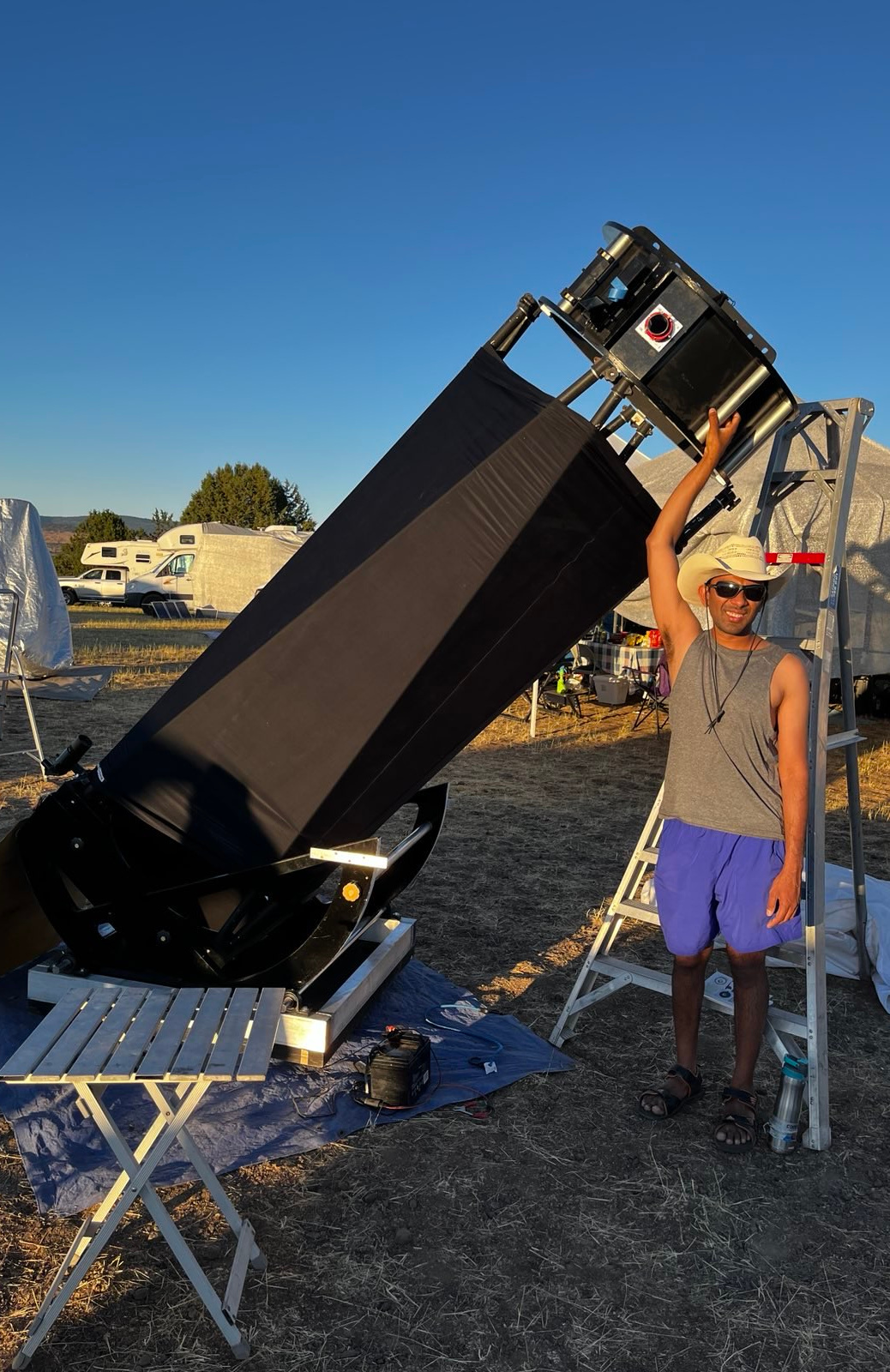 Posing with my 28-inch telescope at Golden State Star Party 2024
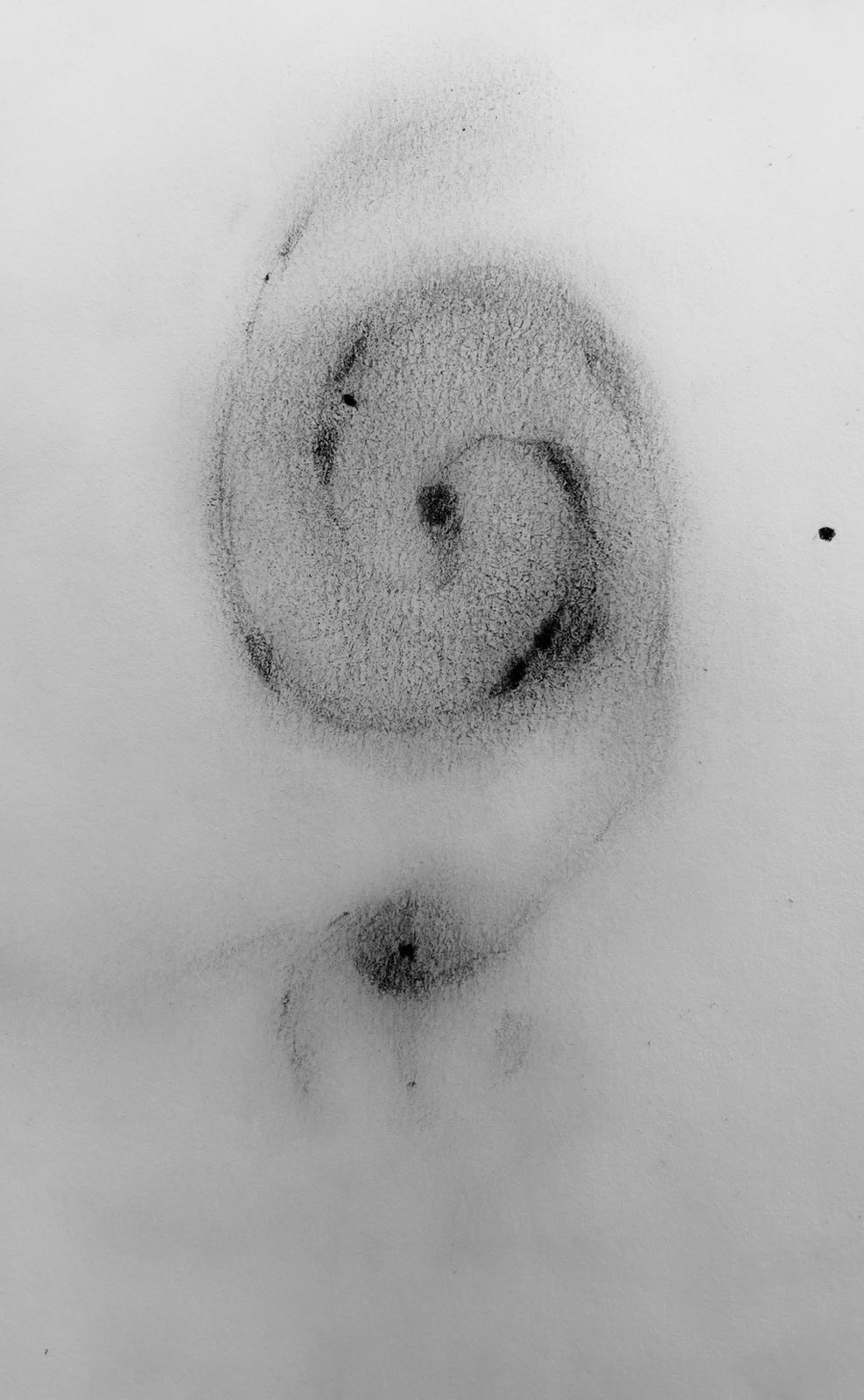 Sketch of the Whirlpool Galaxy made at the eyepiece of my 18-inch telescope